
Porto Badisco
TRACCE no. 4 – by Angelo Fossati
The state of the research: Alpine and Italian post-palaeolithic Rock Art 1990-1995
* Part 3 - The Eastern Alps, Italy and the Balkans *
After the first discoveries of rock art in Austria, about 30 new sites have been discovered in Tirol, Niederösterreich, Salzburg and Stiria…
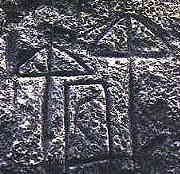
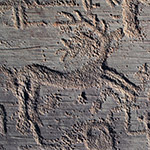
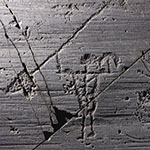
Kienbachlamm (A) middle age figures
After the first discoveries of rock art in Austria (in the Totes Gebirge mountain) during the fifties, about 30 new sites have been discovered in Tirol, Niederösterreich, Salzburg and Stiria. The major part are in the Salzburg area and are usually engraved by scratching the limestone surfaces using some stone or metal tools. The figurative themes are quite different: we can see cows, dogs and wolfs, horses, deer, goats, ibexes, bears, birds, anthropomorphs, artifacts, crosses, sexual signs, maps, stars, dates and inscriptions. As usual in rock art they appear alone or in association.
The chronology of this rock art is quite controversial: there are two school of research that support different hypothesis.
- The more traditional school, originated from E. Burgstaller, thinks that the major part of the rock art belongs to the late prehistory and in the old phases of the Middle Age. According to Burgstaller the oldest figures would belong to the Epipalaeolithic (1).
- The other school, represented by the ANISA, an association founded in 1979 at Gröbming in Stiria, has recently collected the documentation of about 25,000 petroglyphs that they consider much more younger, mediaeval and recent. For the ANISA scholars the engravings have been made by shepherds, woodcutters and hunters (2).
We think that a middle way can be found between the two different interpretations that seems to be so distant. If it is surely difficult to support the antiquity of the zoomorphic figures of the Totes Gebirge (on the other hand I could not find them standing in front of the rock), it is also hard to confirm that there is no prehistoric rock art in Austria when we see hunting scenes and zoomorphic figures that can be compared with the camunnian rock art or the hallstattian decorated pottery. It is also undeniable that there is medieval and modern rock art, represented by crosses, dates and weapons.
I would like to underline, also, the similarities of the Austrian rock art with the so-called Cimbrian rock art of the Asiago highlands, an area studied during the eighties (3) but newly recorded in 1993 by a team of the Footsteps of Man. It is confirmed that this old population, the Cimbri, during the Middle Age came from the north, from a German region (Austria?): in fact the local dialect, still spoken, is an old German dialect called zimbro. But if the major part of the figures (fig. 18; crosses, little cup-marks, five-points stars) belongs to Medieval or Recent times, and it is the same that we can find in Austria, only few representation can be attributed to the Late Iron Age (topographical and architectural representations) and at Asiago it is completely absent just that phase older and well attested in Austria, in which we can recognize the zoomorphs, the riders and the hunting scenes (4).
Italy
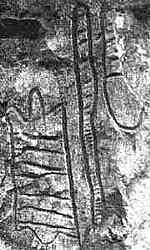
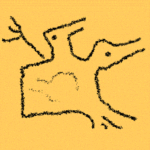
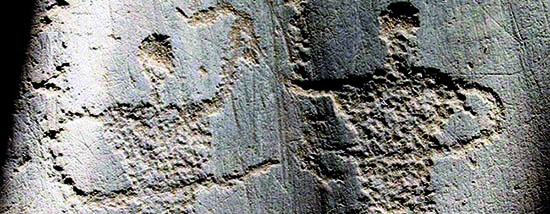
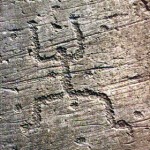
Sfinalicchio (Puglia – I) idol-shape engraved figure (by Tunzi Sisto, NAB 2)
Only the Puglia region, in the southern Italy, has given novelties in the rock art research, due to the efforts of local investigators, like G. Ruggieri, and the interest of the inspectors of the Archaeological Superintendency, A. Tunzi Sisto.
We can find two different situations: one more connected to “parietal” rock art sites, and this is the discovery of some rock shelters or little caves with schematic petroglyphs that are not yet surely dated; the second type of rock art is connected to the engraved boulders, chronologically confined to the Copper Age.
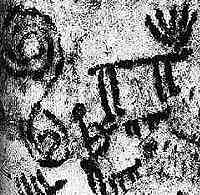
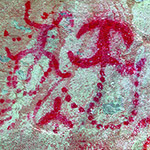
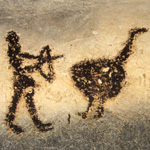
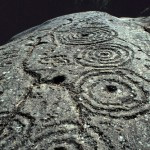
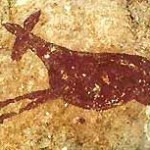
Porto Badisco (Puglia – I), hunting scene and spirals (by Graziosi, 1980)
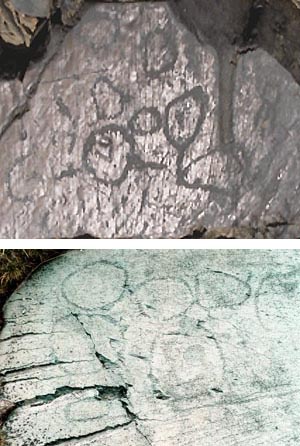
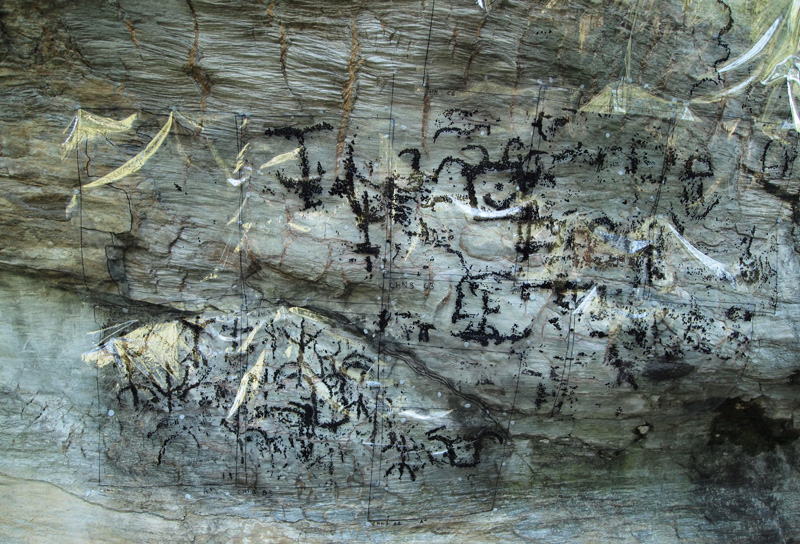
In the first case we must remember the rock shelters B and C of Sfinalicchio, in the beautiful frame of the Gargano: here there are different linear (scratched) figures probably symbolizing the female and male sex (fig. 18).
In the second case we find the anthropomorphic stela of Bovino, where, in addition to the usual iconography of the Copper Age, that is daggers or collars, we can see some engravings: a deer, a goat, a fish, petroglyphs not usually etched in these monuments, but common in those of Valcamonica (5).
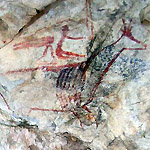
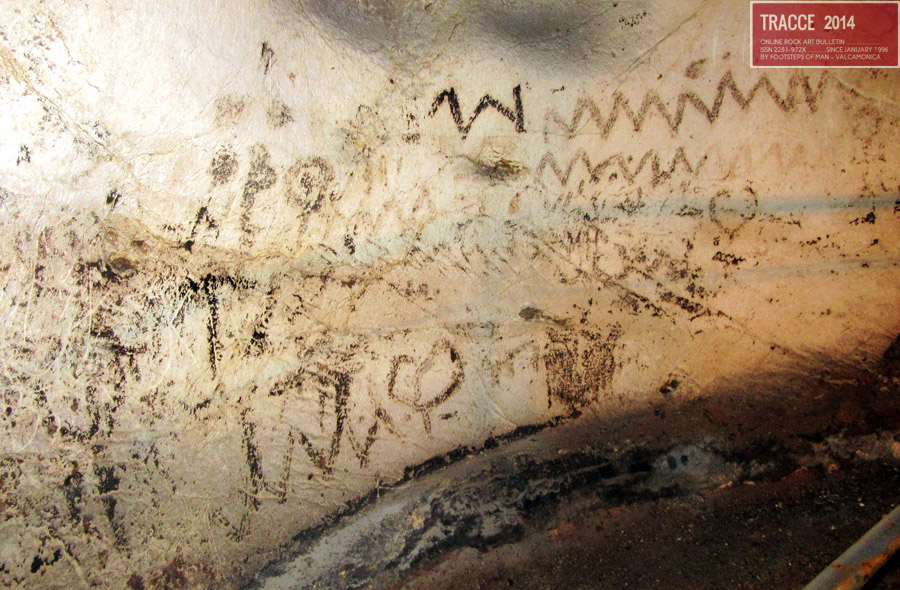
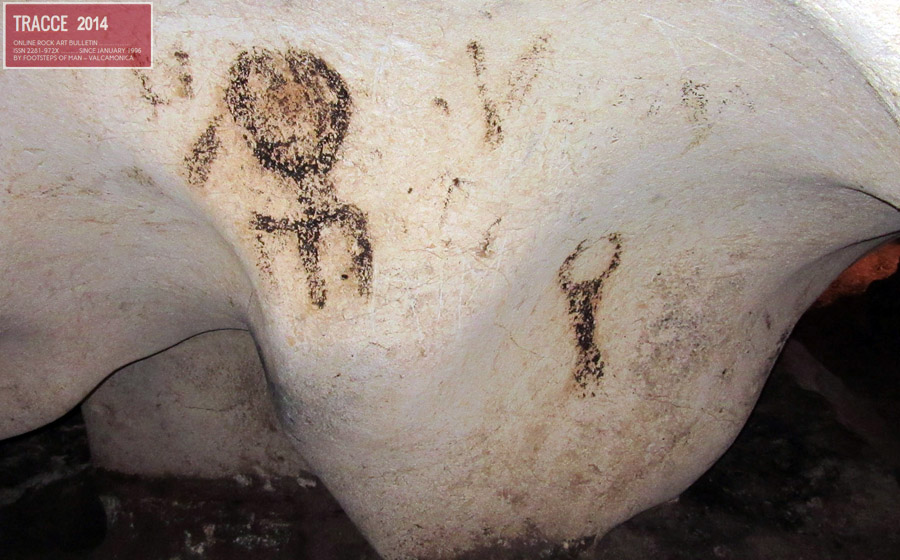
We do not have any other news from the most famous cave with rock art of Puglia, the Porto Badisco cave, where P. Graziosi could recognize Neolithic and Copper Age paintings. In this sense it is noteworthy that the Archaeological Superintendency of Sicily is preparing a special conservation program for the Addaura caves (Palermo) (6).
The Balkans
The Balkans, due to the recent political and war problems present only few sites from the Republic of Macedonia (former Yugoslavia). The discoveries have been done by D. Aleksovski of the Rock Art Research Association of Macedonia, Kratovo, that starting from 1992 found some rocks engraved. Aleksovski has attributed these figures to four different phases: while the first three are referred to pre- and protohistoric ages, the last has been ascribed to the historic and Christian period (7).
Continued from (previous TRACCE issues):
Cooperativa Archeologica Le Orme dell’Uomo
piazzale Donatori di Sangue 1- 25040 CERVENO (Bs), Italy
tel. 39-364-433983 – fax 39-364-434351
A word of thanks: I wish to extend my gratitude to the colleagues that have pass to me the information or material without those I could not have written many paragraphs of this article: A. Arcà and the friends of the Gruppo Ricerche Cultura Montana of Turin, F. Ballet, S. Casini, P. Frontini, R. De Marinis, F. Fedele, F. M. Gambari, S. Gavaldo, A. Kopf, L. Mano, A. Pedrotti, D. Seglie and the friends of the CeSMAP of Pinerolo, A. Santacroce, U. Sansoni
BIBLIO
- BURGSTALLER E., 1972. Felsbilder in Österreich, Landesinstitut für Heimatpflege und Volksbildung, Linz.
- MANDL F., H. MANDL-NEUMANN,1993. Rock art in Austria, in INORA, 5, pp. 17-23, Foix.
- PRIULI A.,1983. Le incisioni rupestri dell’Altopiano dei Sette Comuni, Priuli e Verlucca, Ivrea.
- FOSSATI A., 1995c. Lungo i sentieri di caccia, in Sui sentieri dell’arte rupestre, A. ARCA’- A. FOSSATI (eds.), pp. 158-160, Torino.
- TUNZI SISTO A., 1995. Testimonianze di arte rupestre nella Puglia settentrionale, in NAB, 2, 1994, S. CASINI (ed.), pp. 155-162, Bergamo.
- BAVASTRELLI S., 1995. The conservation of rock art in Addaura’s caves (Palermo), communication in NEWS 1995, international rock art congress, Turin.
- ALEKSOVSKI D., 1993. Recherches de l’art rupestre de la République Macédoine,
in “Survey”, V-VI, 7-8, 1991-1992, pp. 21-30, Pinerolo.






















Leave a Reply