Lascaux cave
TRACCE no. 2 – by Andrea Arcà
If we imagine any HOST of the web as a directory and every URL as a file of a unique computer, we can immediately realise that we are working with the biggest data “store” ever created by man. The electronic memory grows day by day, HTML by HTML, JPG by JPG. If Rock Art plays a good role in the web, it’s sure that the web could play the best role for Rock Art.
Rune stones
The problem is one, and perhaps the most significant: Rock Art researchers need to exchange data (texts) and images (pictures andtracings). Books are the best tool, the most scientific and accurate, but sometimes hard to find, to reach, even to know. Why not ask the web to play this role of world-wide overview
being able by its nature to link many different situations, to trace the way to reach a complete bibliography or to show a short summary of a site like a visual fieldtrip?
It's time to propose to all Rock Art researchers and organisations the finding of a place in the web, creating a specific URL for each Rock Art site and/or culture.
It’s not a problem of standardisation: research is different from area to area. In fact I can (obviously) propose for each relevant site:
- an archaeological presentation of periods and cultures;
- a scientific report about recording methods;
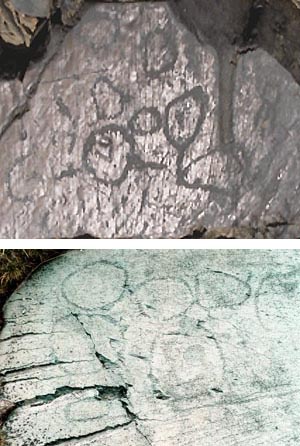
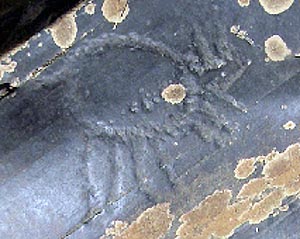
- a good choice of pictures and tracings, to show main typologies and kinds of painted or engraved figures;
- it will be useful to know if there are some preservation problems and how they are or they could be resolved (park, museum, guided field-trip, closed area);
- we can add a specific bibliography,
- and, if possible, an open space for questions and suggestions, like a “guestbook”.
Some problems are coming out regarding site localisation. Recently maps have been included in a very well done WEB page of North California Rock Art. There is no danger in the specific situation: but in general it’s better to avoid detailed descriptions of localisation if the site is not protected or not included in a park or in a managed area.
I recently reached 180 Rock Art (virtual) sites on the web. I found a great assortment,
from a picture without any explanation to a complete exhibition of a site. I can briefly refer to some of them (see also Rock Art links by Bob Edberg).
Lascaux cave
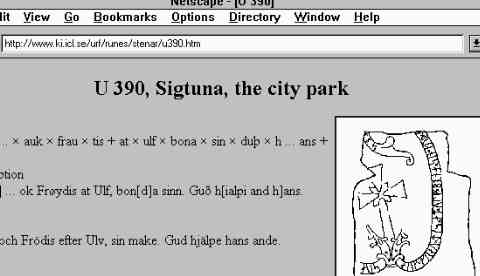
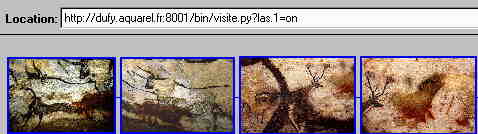
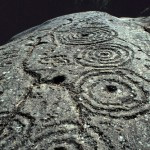
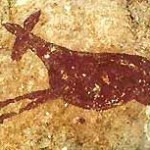
At Lascaux cave we have an excellent presentation, with archaeological text and pictures of many painted panels. We would need perhaps more information about the problems which caused the building of a perfect duplicate in these last years (Lascaux 2). We can find a fascinating choice of images about Knowth tumulus (Ireland, Neolithic), unfortunately without text. If you are looking for a good pattern for your Rock Art web page you must reach Uppland rune stones in Sweden. The touristic management of the Sanilac Petroglyphs, Bad Axe, is very attractive, with interpretive program and nature trail hike. You can have the best visual idea of what is an engraved rock at Owens Valley California site, by Frank Lyon Cox. A B/W enhanced photo of the engraved surface is accompanied by a panoramic view.
The Rock Art Foundation site is waiting for your visit: here you find exhaustive texts, a spectacular choice of images, and also a newsletter page. If you are looking for a reliable archaeological exposition reach the Petroglyphs of Fujairah page, by Grégoire De Ceuninck: iconography and interpretation. A curiosity: you can hear (Real Audio needed) or read a good report about the Chauvet cave discovering. (an Earth and Sky program). On the other hand it’s impossible to find something about Rock Art of the Sahara or of Africa.
In Europe we have only 1 picture of Altamira, nothing about Mt. Bego, and even in Australia it’s not easy to find a completely described site.
The web is growing, now and tomorrow, like each hard disk of our computers. There is the space to upload if not a huge Rock-Art graphic database (but the web IS by its nature a huge database…), at least a choice of the most interesting materials.
I hope that it will be possible to open a debate in this sense!
CERVENO (Bs), Italy tel. 39-364-433983 – fax 39-364-434351















Leave a Reply