

 Rock Art in the Alps - The engraved rocks of Carschenna
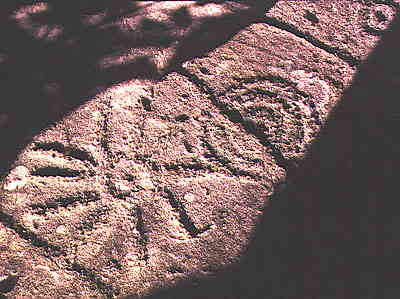
Cup-marks are usually surrounded by 1 to 9 circles. On the rock n. 7 we can find also spirals. Cup - marks are often related by long channels. On the rock n. 3 (picture above) we can find a solar representation. All the engraved rocks are under a thick wood of fir-trees. Superimpositions.
Schematic horses and riding scenes are very similar to the Valcamonica
ones. In Valcamonica (Alps) they are currently dated to the first Iron
Age (VIII-VII century b.C.), by comparisons with decorated pottery and
by the fact that in this region the horse was not ridden before this
period. At Carschenna schematic horses cover concentric circles: so concentric
circles are more ancient, and must be dated to the Bronze Age. Phases. Finally we can distinguish at least between three phases, in order:
Interpretation. Carschenna concentric circles are identical to the Pontevedra (Spain) and to the Scottish ones. Likenesses can't be casuals, so they probably belong to the same culture. In the Alps we can find concentric circles in Valcenischia (Western Alps) and at Sonico (Valcamonica). At Sonico they are covered by little shovels of the first Iron Age. Carschenna engravings are not easy to interpret. Some scholars suggest a topographic key. They were studied by C. Zindel and G. C. Borgna. Imaging. The pictures have been taken with daily grazing light, obtained with sun and mirrors. Slides have been scanned by a slide transparency scanner. More Carschenna
1. ZINDEL C., 1970. Incisioni
rupestri a Carschenna, in Valcamonica Symposium, 1968,
pp. 135-142, Capo di Ponte These pictures are not available for
any commercial use. Please contact
us

Sui
Sentieri dell'arte rupestre Rock Art research tools
on Amazon
© Andrea
Arcà 30-Jun-96,09:27:58
|