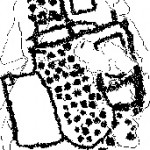
Vite rock 20
TRACCE no. 2 – by Andrea Arcà
The Settled Ground
in the “Topographic” Engravings
of the Alpine Arc
.
The stylistic affinities
While each group of Alpine valleys has particular characteristics, analysis of the total allows one to see in each period of prehistory substantial affinities which demonstrate a great wealth of iconographic, stylistic and cultural contacts and exchanges.
The prehistoric rupestrian engravings of the Alpine arc show a close "blood relationship", which is demonstrated when comparing even very distant areas.
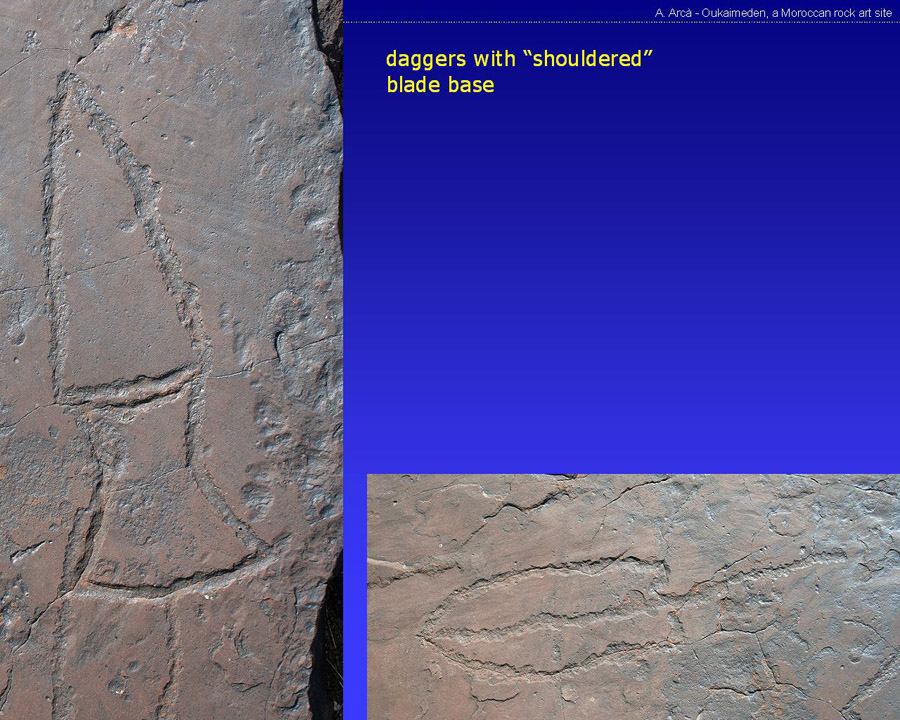
This is seen most clearly in analysis of the statues-stelae, of the monumental compositions and of the engraved menhirs: three different aspects of an only one great iconographic phenomenon of the Copper age, which saw in the knife with triangular blade and half-moon shaped grip (a so-called “Remedellian” type) a kind of “fossil guide” diffused from the rocks of the Western Alps (Ubaye (1), Aosta (2), Vallese (3) to those of the central-eastern Alps (Valtellina (4), Valcamonica (5), Trentino (6) as far as the northern Apennine (Lunigiana (7).
In the ancient Bronze age one cannot miss the close affinities between the composition of axes of the Aosta Valley (Valtournenche (8), of Valcamonica (Foppe di Nadro (9), Luine (10) and of the eastern bank of Lake Garda (Castelletto (11).
In the first Iron age there are clear similarities between the duelling and hunting scenes (deer-steinbock) of Valcamonica and of the Valleys of Moncenisio.
Moreover, for each similarity in style there is a corresponding similarity in content. Thus, it is not a matter of assuming an a priori scientific validity purely on the basis of the “style” of figurative engravings. Taken in isolation, such characteristics could deceive. However, when they are supported by symbols of objects, such as weapons or tools, that are found in datable archaeological deposits, or by the presence of superimpositions they become a valid parameter for assessing chronologies.
From Valcamonica to Bego
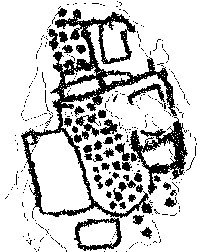
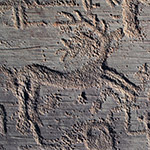
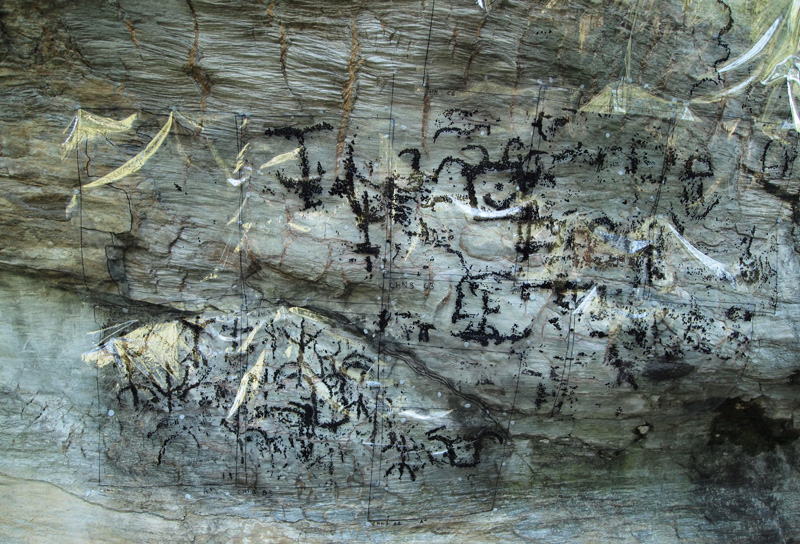
Vite Rock 20 (Valcamonica)
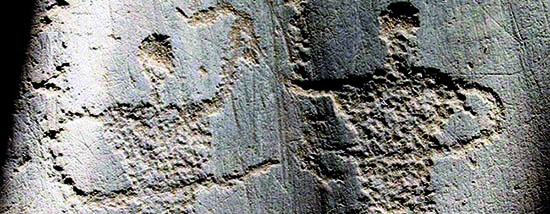
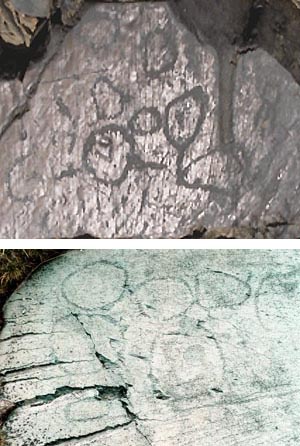
By topographic engravings one referes to repeated geometric modules, regularly delimited and subdivided, bordered by perimetric lines, which bring to mind the representation of a settlement. On the other hand words like “plot of ground”, cadastral “particle”, and “lot” have in common an original concept of subdivision and delimitation of the territory.
Whoever should aim at finding points of contact between the two greatest "poles" of Alpine Rock Art would find a fertile battle-ground in the so-called topographic engravings.
To the first important scholar of the rock art of Mt. Bego, C. Bicknell, one owes the original hypotheses regarding such engravings. On page 65 of the Guide to Prehistoric Rock Engravings of the Italian Maritime Alps (1913) we can read in fact:
- If the engravers who engraved the figures to represent their ploughs with oxen, or probably their roofings too had wanted to paint one of their dwellings with their respective herds or flocks they could not have done it, even though symbolically, in a more similar way to true life.
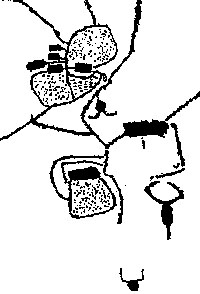
“The Village of Mt. Bego”
In this passage C. Bicknell refers to a certain kind of figure present in the Fontanalba sector. These are characterized by rectangular nuclei that are totally pecked, surrounded by curved lines and filled by dots in an orderly arrangement. Even today whoever observed a gias from above (gias in the local piedmontese dialect, from the Latin giacere, the seasonal refuge for cows and sheep) would have to agree with what Bicknell said.
Identical engravings can be found in many sites of Valcamonica. Some of these are inserted between the II and III styles identified by Anati with a chronology attributed to the end of the 3rd or beginning of the 2nd millennium B.C.
However, Anati does not appear to have focussed specific attention on this phenomenon. The topographic figure with rectangular double base present on Bagnolo I is not indicated as such (12) and the topographic composition of the Rock of the Spirits (Paspardo Games Park) is interpreted as a mythological anthropomorphic figure (13). Moreover, in the list of typological codes , the topographic engravings are present with eight typologies.
To continue with (next TRACCE issues):
- Part 2 - Chronology
- Part 3 - Diffusion
- Part 4 - Interpretation
Pictures (from top):
- Vite (Valcamonica, I), rock no. 20 (tracing by Orme dell’Uomo)
- Mt. Bego (F), the Rock called “The Village of Mt. Bego (tracing by H. De Lumley)
CERVENO (Bs), Italy. tel. 39-364-433983 – fax 39-364-434351
BIBLIO
- MULLER A.-JORDA M.-GASSEND J.M., 1991. Les gravures préhistoriques de la vallee de l’Ubaye (environ du lac du Longet) et les modalités du peuplement de la zone intra-alpine, in Le Mont Bego, une montagne sacrée de l’Age du Bronze, prétirage des actes du Colloque de Tende 5-11-juillet 1991, Tome I p. 155-161 and ARCA’ A.-FOSSATI A., 1995. Sui sentieri dell’arte rupestre, CDA, Torino, p. 34-37
- MEZZENA F., 1982. La Valle d’Aosta nella preistoria e nella protostoria, in Archeologia in Valle d’Aosta, Regione Valle d’Aosta, Aosta, p. 23-50
- BOCKSBERGER O.J., 1976. Le site préhistorique du Petit Chasseur. Le Dolmen M VI, in Cahiers d’archéologie Romande 7, Lausanne and GALLAY A.-CHAIX L., 1984. Le site préhistorique du Petit Chasseur. Le Dolmen M XI, Cahiers d’archéologie Romande 31, Lausanne
- POGGIANI KELLER R., 1989. Le stele dell’età del Rame, in Valtellina e mondo alpino nella preistoria, Panini, Modena, p. 40-46; CASINI S.-FOSSATI A. 1994. Le stele e i massi incisi della Valcamonica e della Valtellina nell’ambito dell’arco alpino, in Le Pietre degli Dei. Menhir e statue stele dell’età del Rame in Valcamonica e Valtellina, a cura di S. Casini, Bergamo, p. 59-68; FRONTINI P.-POGGIANI KELLER R. 1994. Statue stele e massi incisi della Valtellina, in Le Pietre degli Dei. Menhir e statue stele dell’età del Rame in Valcamonica e Valtellina, a cura di S. Casini, Bergamo, p. 151-157
- ANATI E., 1982. Il problema indo-europeo: composizioni monumentali
e statue-menhir del calcolitico, in I Camuni alle radici della civiltà europea, Jaka Book, Milano, p. 200 e CASINI S.-FOSSATI A. 1994 - PEDROTTI A., 1993. Uomini di pietra, i ritrovamenti di Arco e il fenomeno delle statue stele nell’arco alpino, Provincia Autonoma di Trento
- AA.VV., 1994. Antenati di pietra. Statue stele della Lunigiana e archeologia del territorio, Sagep, Genova
- DAUDRY D., 1982. Art rupestre de la Valláe; d’Aoste, Cahiers Museomontagna 19, Museo Nazionale della Montagna, Torino
- CITTADINI T., 1991. La riserva naturale delle incisioni rupestri di Ceto, Cimbergo e Paspardo, p. 24
- ANATI E., 1982. Il periodo III: calcolitico ed età; del Bronzo, in Luine collina sacra, Edizioni del Centro, Capo di Ponte, p. 137-178
- GAGGIA F., 1982. Le incisioni rupestri del Lago di Garda, p. 33, Verona
- ANATI E., 1976. Evoluzione e stile nell’arte rupestre camuna, Edizioni del Centro, Capo di Ponte, p. 76
- ANATI E., 1982. I Camuni alle radici della civiltà europea, Jaka Book, Milano, p. 200




















Leave a Reply